
5 Ways to Improve Call Center Onboarding Without Slowing Down Ops
New Reality: AI Is Redefining Call Center Onboarding
Today’s contact center leaders face a balancing act: ramp agents faster, improve call quality, and avoid disrupting daily operations.
But traditional onboarding hasn’t kept up. Lengthy classroom sessions, inconsistent roleplay, and slow feedback loops are still common — even though they rarely translate into better performance.
And that gap is costly. According to McKinsey, high-performing agents are up to 3x more productive than low performers. Meanwhile, ICMI reports that 62% of contact centers take more than two months to fully onboard a new agent. That’s too long.
The opportunity? AI-powered onboarding that lives in the back office. You can safely optimize training where it won’t affect customers — giving your team faster ramp times, better data, and more control.
1. Identify High and Low Performers Early
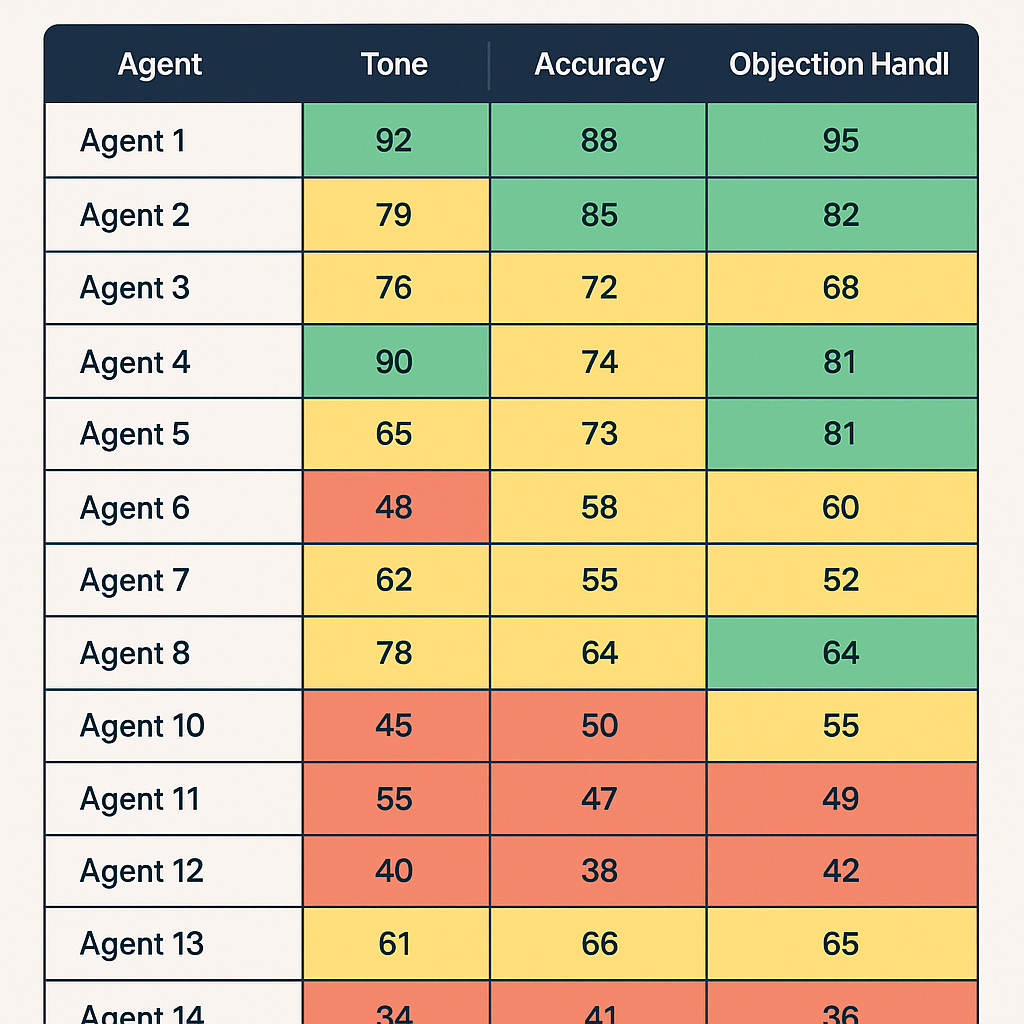
The earlier you can separate high-potential hires from poor fits, the better. Early training is your chance to assess not just skills, but coachability — a leading indicator of long-term success.
Many leaders hesitate to cycle out low performers too soon. But dragging them through onboarding can waste thousands in time and wages, while slowing your coaches down.
Action Tip:
In the first week, score mock calls using a rubric with clear categories: product accuracy, tone, active listening, and objection handling. Use this data to tag coachable agents for fast-tracking, and move on quickly from those who aren’t progressing.
2. Track Performance Before the First Real Call
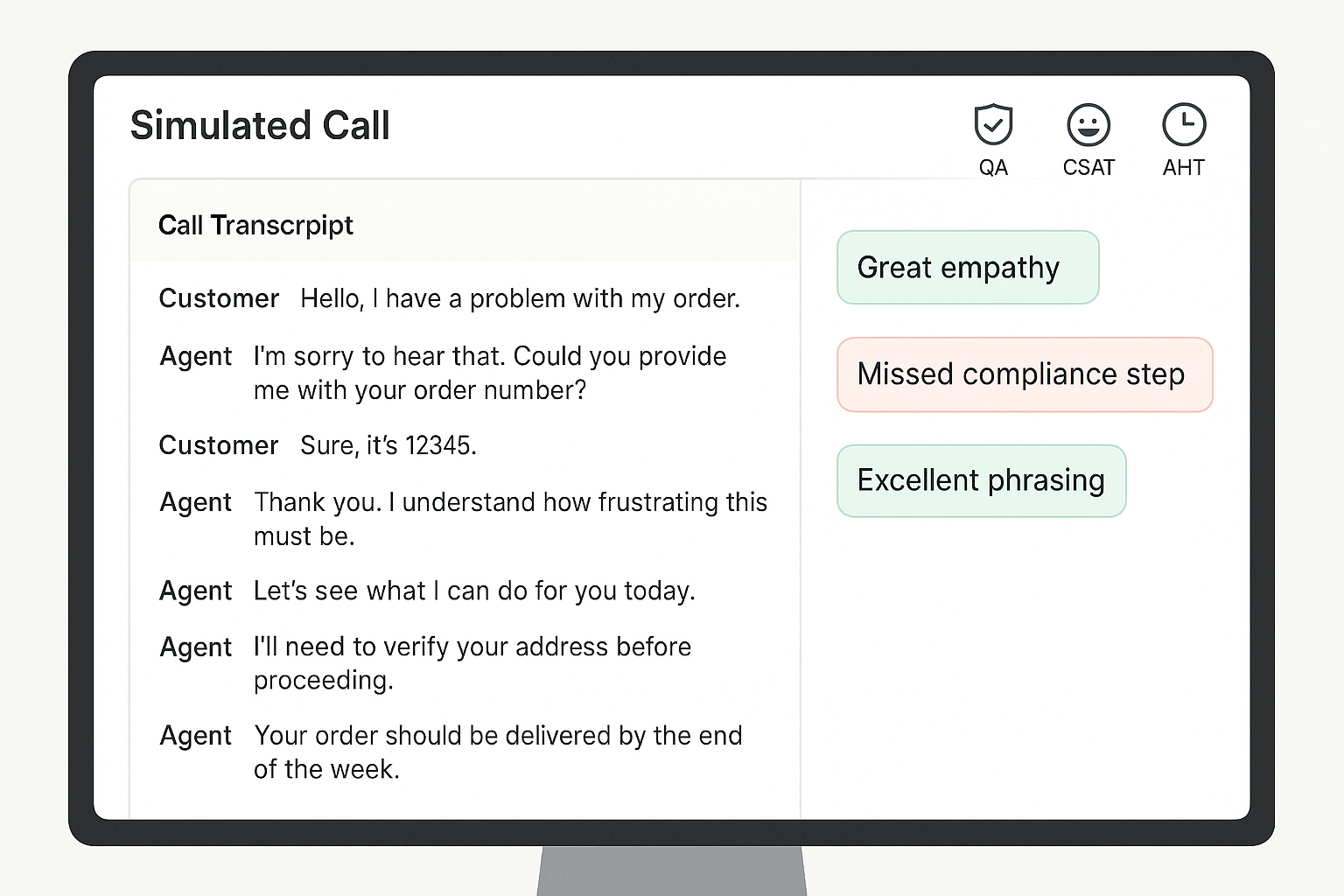
Your first live call shouldn’t be the first time you assess an agent’s skills.
Without early benchmarks, it’s impossible to know who’s ready — or what good looks like. That’s why simulated performance tracking is key.
Leading teams are using AI-powered roleplay and simulation to measure call handling, QA adherence, and even mock CSAT before agents hit the floor. This reduces the chance of bad first impressions with customers.
Action Tip:
Use virtual customers to simulate key scenarios during onboarding. Track how each rep performs on scripted calls, objections, compliance, and empathy. Benchmark performance across day 1, week 1, and week 4.
3. Make Practice Safe, Frequent, and Feedback-Rich
Live roleplays are useful, but they’re often inconsistent. One coach might give thorough feedback while another lets agents skate by. Worse, they’re time-consuming.
Practice needs to be low-risk, repeatable, and paired with instant feedback. AI makes this possible. Simulated calls can happen anytime, anywhere, and every interaction can be scored against consistent standards.
Action Tip:
Replace ad hoc roleplay with structured simulations powered by virtual customers. Layer in automated scoring and feedback, so agents always know what to fix. Aim for 3–5 short simulations per module, with a minimum passing score required to move on.
4. Optimize for Your Fastest Rampers
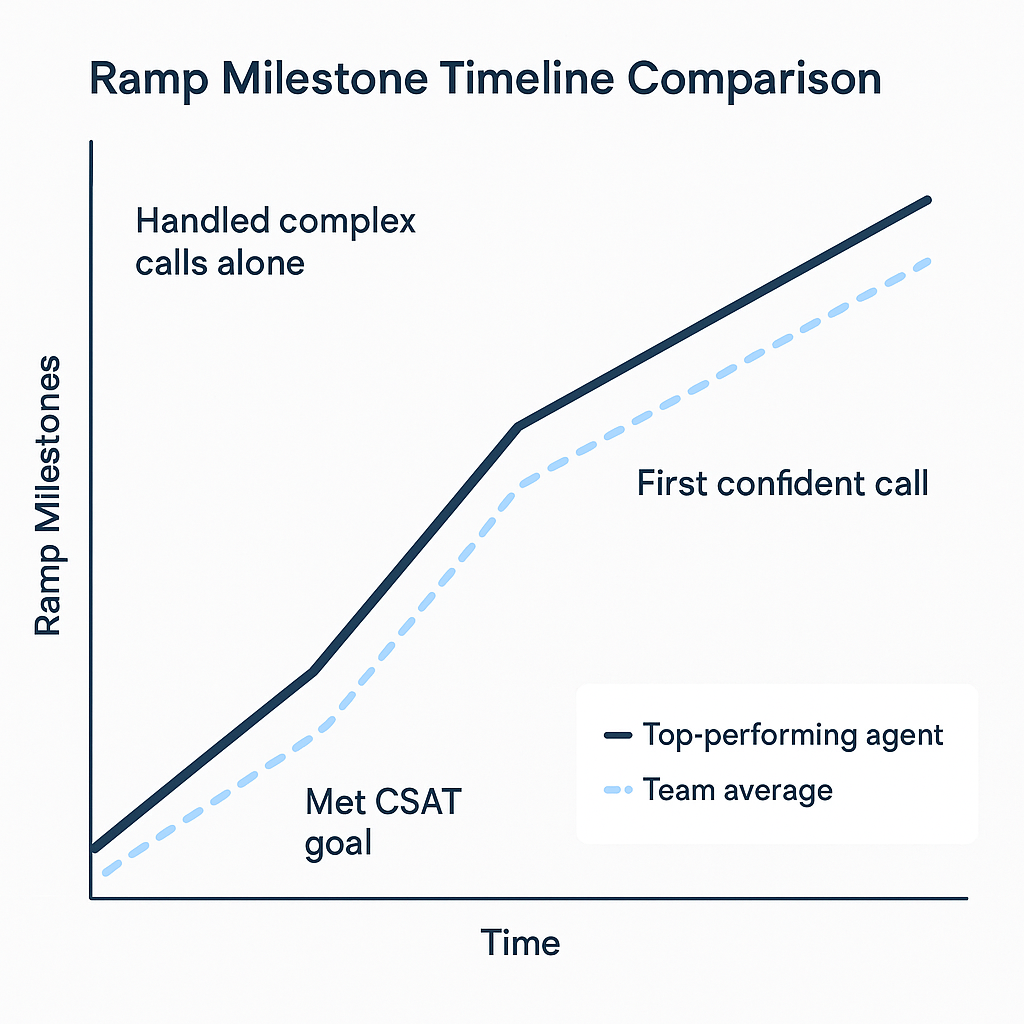
A Salesforce study found that shortening ramp time by just 10% led to a 12% increase in agent productivity. Source
Most onboarding is designed for the average hire. That drags down your timeline.
Instead, study your fastest-ramping agents and reverse-engineer their path. When did they become proficient? What practice helped them most? What milestones did they hit and when?
This approach lets you rebuild onboarding around outcomes — not activities.
Action Tip:
Track your top performers’ onboarding journey across three milestones:
- Time to confident first call
- Time to hit CSAT / QA targets
- Time to independent handling of complex scenarios
Use those patterns to redesign your onboarding flow around results, not just schedules.
5. Shift from “One and Done” to Ongoing Micro-Coaching
Most agents regress after onboarding if they don’t get regular coaching. But teams are often too busy to keep supporting new hires beyond week one.
That’s where micro-coaching comes in. By pushing small, targeted refreshers based on real call data, you can keep agents sharp without adding to your team’s workload.
Action Tip:
Create a 30/60/90 day plan that combines live call reviews with 5–10 minute refreshers. Use AI to flag skill gaps and trigger the right micro-lesson. Consider peer coaching too — it boosts engagement and reinforces best practices.
Call Center Onboarding Optimization Checklist
Here’s your quick-start reference for streamlining onboarding without sacrificing quality.
Agent Evaluation (Week 1)
☐ Score every agent on coachability using mock or simulated calls
☐ Use a rubric: tone, product accuracy, objection handling
☐ Tag high-potential agents for fast-tracking
☐ Part ways early with non-coachable hires
Performance Benchmarks
☐ Set QA, CSAT, and AHT targets for day 1, week 1, and month 1
☐ Use simulated environments to pre-test before live calls
☐ Track new-hire performance in a shared dashboard
Training Program Design
☐ Focus on practice and feedback over slide-heavy sessions
☐ Use AI-driven simulations instead of manual roleplays
☐ End each module with a pass/fail assessment or mock scenario
AI & Automation Integration
☐ Deploy Intelligent Virtual Customers for scalable mock calls
☐ Automate scoring and feedback to free up coaches
☐ Use performance data to trigger just-in-time coaching
Ongoing Reinforcement
☐ Build a 30/60/90 day roadmap with checkpoints and refreshers
☐ Push short, targeted lessons based on call performance
☐ Enable peer reviews and shared call feedback
Final Thoughts: Onboarding Doesn’t Have to Be a Bottleneck
Modern onboarding doesn’t have to mean slowing down operations or risking the customer experience.
Training lives in the back office. That’s where innovation can thrive — and where AI can safely support your team.
If you're ready to reduce ramp time while giving your agents more practice, more feedback, and a smoother path to proficiency, TrueCX can help.
Explore how TrueCX's Intelligent Virtual Customers enable faster, smarter onboarding — without slowing down your floor.