
AI Training for Contact Center Agents, The Future of Onboarding & Readiness
Reinventing Agent Readiness in the Age of AI
Contact centers are facing a training and onboarding crisis. Traditional methods, classroom sessions, generic scripts, and shadowing, were built for a world where new agents could start with simple, low-stakes calls and gradually build their skills. But that world is gone.
Automation and self-service have stripped away those entry-level interactions, leaving new hires to confront complex, emotionally charged issues on day one. This has turned into longer ramp times, higher attrition, and costly inefficiencies that directly impact customer experience.
AI presents a new path forward. By leveraging AI training for contact center agents, leaders can reimagine onboarding as a scalable, personalized, and data-driven process. Through contact center training simulations powered by Intelligent Virtual Customers (IVCs), new hires can safely practice realistic customer conversations, receive instant feedback, and progress only when they demonstrate true readiness. This approach not only accelerates proficiency but also boosts agent confidence, reduces trainer burden, and builds resilience in an era where every customer interaction matters.
For contact center executives: AI isn’t just transforming how agents serve customers, it’s transforming how we prepare them to succeed.
Rising Complexity of Customer Interactions
The contact center has always been a challenging environment, but the landscape has fundamentally shifted. Low-effort, transactional calls - think about password resets, simple account lookups, straightforward policy questions - they are now handled by self-service portals, automation, or chatbots.
What remains are the higher-stakes, emotionally charged, and technically complex conversations. New hires often face these situations from their very first live call, without the benefit of building skills gradually.
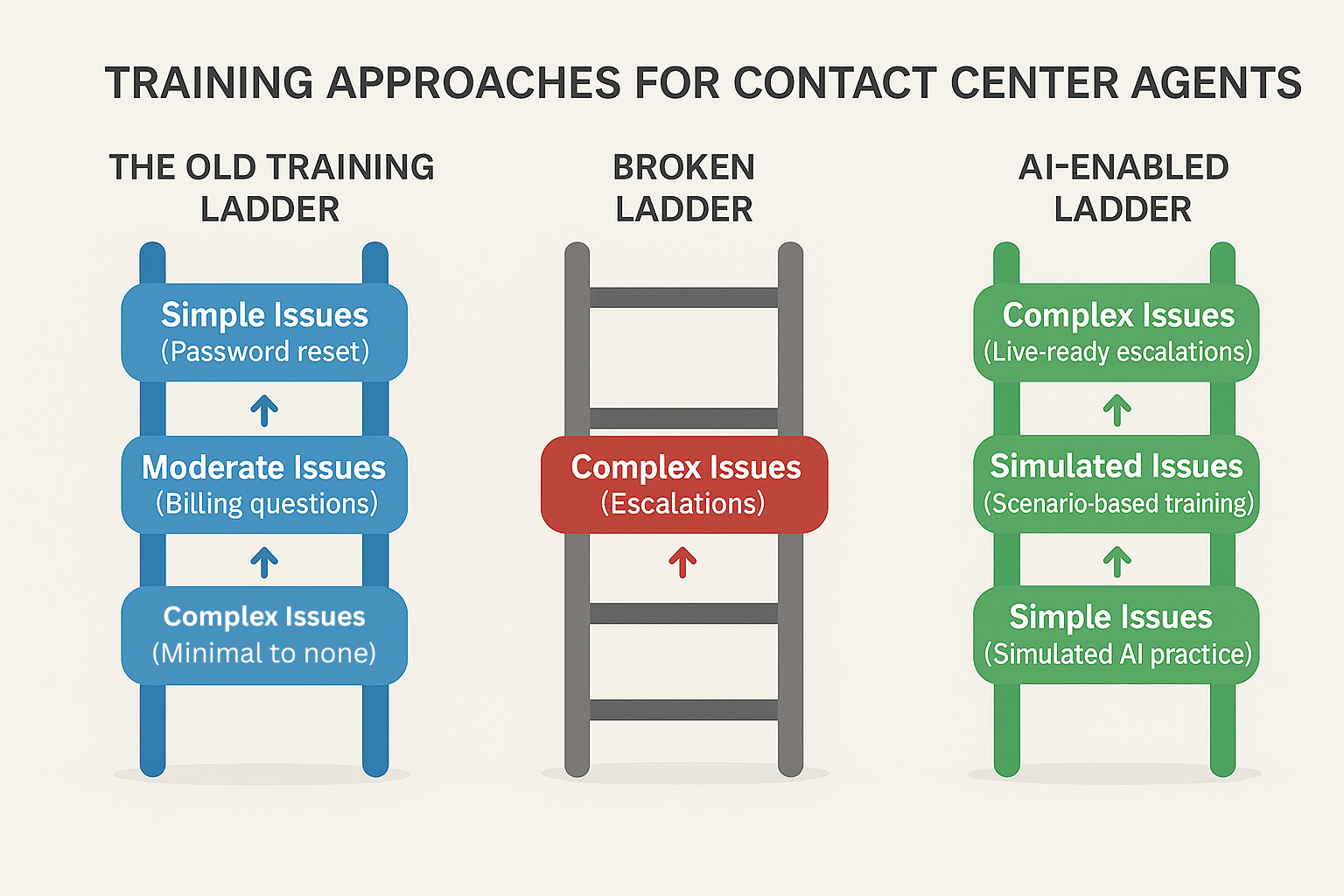
The “Broken Ladder” Effect
Historically, onboarding followed a natural learning curve. Agents began with simple issues, gained confidence, and then worked their way up to more complex customer interactions.
With AI taking over those easier calls, that ladder has collapsed. Agents are no longer “cutting their teeth” on manageable tasks — they’re being thrown straight into the deep end. The result is high stress, low confidence, and an increased likelihood of burnout or attrition in the first 90 days.
Inefficiencies in Legacy Training Models
Despite these changes, many training programs still rely on outdated methods:
- Static classroom modules that don’t adapt to individual strengths or weaknesses.
- Generic scripts that fail to mirror the real-world variety of customer conversations.
- Trainer-heavy shadowing sessions that are costly, inconsistent, and difficult to scale.
These methods are no longer sufficient for preparing today’s workforce. They consume significant resources while failing to deliver measurable readiness.
The Business Impact for Leaders
For contact center leadership, the consequences of ineffective onboarding are profound:
- Longer time-to-proficiency: New hires take longer to reach productivity benchmarks.
- High early attrition: Frustrated or overwhelmed agents leave within the first few months.
- Customer experience risks: Rookie mistakes in live interactions directly affect CSAT and brand reputation.
- Escalating costs: Increased trainer hours, re-hiring, and re-training compound the financial burden.
The message is clear: the traditional onboarding playbook no longer aligns with the realities of a modern, AI-driven contact center environment. Leaders need a strategy that acknowledges this shift and equips agents for success from day one.
Why AI is a Natural Fit for Agent Training
Safe Experimentation
Unlike customer-facing AI deployments, training and onboarding take place in a back-office environment. This makes it a safe proving ground for innovation. Leaders can integrate AI into agent development without risking customer satisfaction or brand perception. Mistakes made in training stay in training, allowing agents to build confidence before going live.
Scalability Without Burnout
Traditional training models are constrained by human capacity — trainers can only run so many roleplays, shadowing sessions, or feedback cycles in a day. AI removes these limitations. It can facilitate unlimited practice sessions for as many new hires as needed, all at once, ensuring no agent is left waiting for time or attention.
Personalized Learning at Scale
Every agent enters onboarding with different strengths, weaknesses, and learning styles. Static curricula fail to account for this variation. AI dynamically adapts to each agent’s performance: slowing down when mastery hasn’t been achieved, accelerating when skills are demonstrated, and targeting development where gaps are most pronounced. The result is a more efficient, individualized path to proficiency.
Data-Driven Readiness
Traditional onboarding relies heavily on observation and intuition. With AI, every practice interaction generates objective data points: how well the agent followed compliance rules, whether they maintained empathy under pressure, how quickly they resolved a simulated issue. These metrics give leaders a clear, measurable picture of readiness — and a more confident transition from training to live calls.
AI Training in Action: Contact Center Training Simulations
For decades, new agents were eased in through job shadowing, classroom roleplay, and a few low-stakes calls. That world doesn’t exist anymore. Today, AI-powered simulations restore that learning curve by letting agents practice with Intelligent Virtual Customers (IVCs) before they ever take a live call.
These simulations aren’t static scripts. They feel real — voices with tone, emotion, and unpredictability — and they adapt to how the agent responds. More importantly, they rebuild the ladder of learning that automation has taken away:
- Realistic roleplay: IVCs replicate actual customer conversations, preparing agents for the messy reality of live interactions, not just “happy path” calls.
- Progressive challenge: Training begins with simpler questions and gradually scales to complex, emotionally charged scenarios.
- Real-time feedback: Instead of waiting for a trainer’s notes, AI flags hesitation, tone issues, or missed compliance steps instantly.
- Confidence building: With repetition in a safe environment, agents walk into production already battle-tested, not wide-eyed rookies.
The combination of immersion, structure, and feedback turns training into something more than knowledge transfer — it becomes confidence transfer. By the time agents meet their first real customer, they don’t just know what to do; they know they can do it. And that makes all the difference.
From Vision to Execution: A Blueprint for AI-Driven Training
Adopting AI in training doesn’t require tearing down your existing onboarding program overnight. Instead, it works best as a staged transformation — layering AI simulations into the areas where they add the most value first, then scaling over time. Here’s a proven framework for leaders:
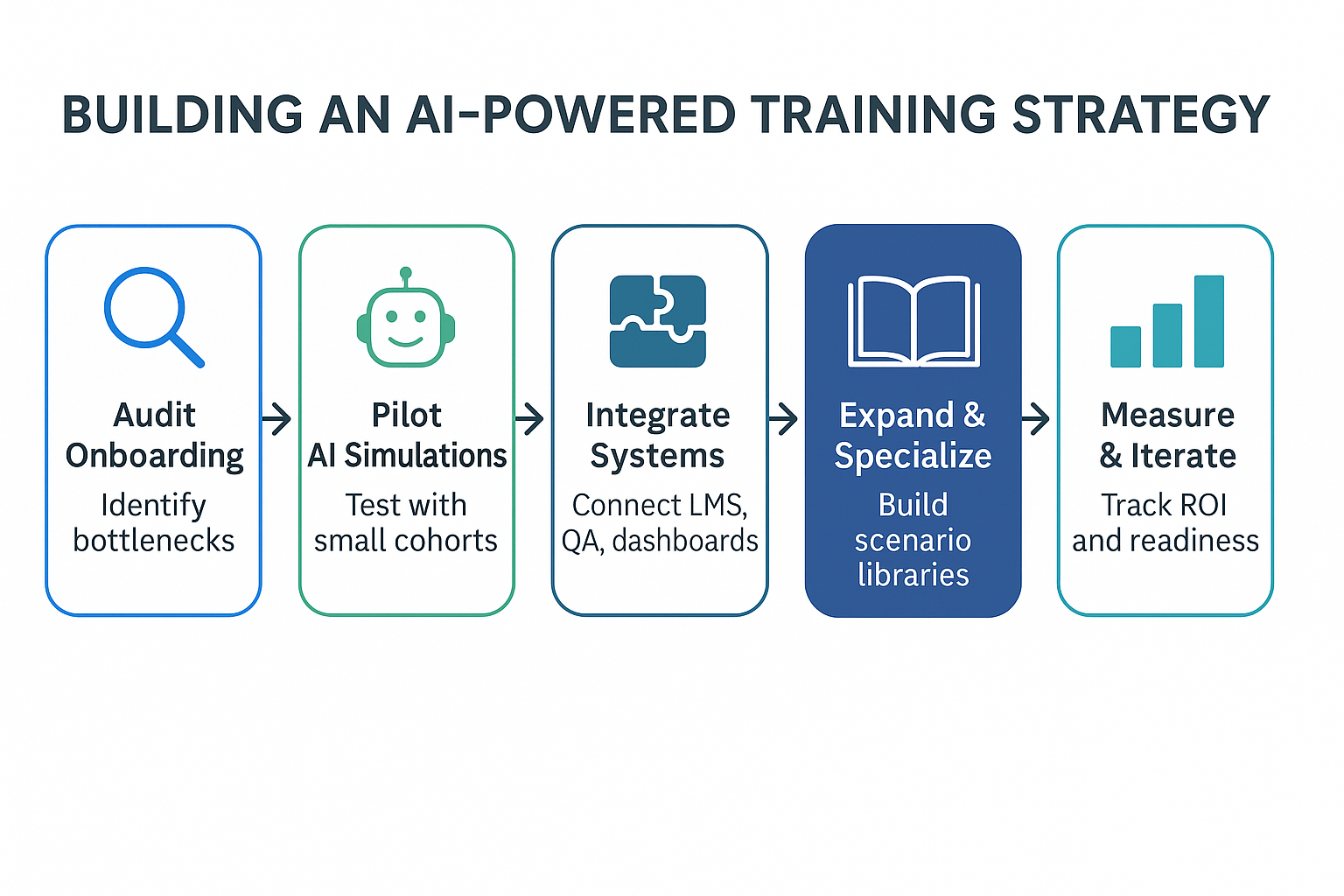
Step 1: Audit Existing Onboarding
Every contact center has unique challenges, but the pain points often look similar:
- Extended nesting periods where new hires sit idle or over-rely on floor support.
- Trainer bottlenecks, with valuable supervisors tied up in repetitive shadowing.
- Rookie errors in live calls that frustrate customers and drive early attrition.
By mapping these inefficiencies, leaders can pinpoint where AI-powered simulations will deliver the biggest ROI first.
Step 2: Pilot AI Simulations
Start small. Select a new-hire cohort and supplement their onboarding with AI-powered practice calls. Focus on a narrow set of use cases — for example, your top three call drivers or common compliance scenarios.
Piloting does two things:
- Proves the concept with measurable results (faster ramp, higher confidence).
- Builds buy-in with trainers and frontline managers, who see the impact firsthand.
Step 3: Integrate into Existing Systems
AI training shouldn’t exist in isolation. To maximize value, it should connect seamlessly with the tools leaders already rely on:
- LMS platforms for centralized learning journeys.
- QA scorecards to ensure consistency between simulation and live performance.
- Performance dashboards so leaders can track progress across the entire workforce.
Integration ensures that AI simulations aren’t a side experiment — they’re a core part of the development ecosystem.
Step 4: Expand and Specialize
Once the pilot proves successful, broaden the scope:
- Create a scenario library that mirrors the real contact center environment: technical troubleshooting, high-emotion complaints, billing disputes, and compliance-heavy conversations.
- Introduce specialized training paths for cross-skilling (e.g., moving a seasoned chat agent into voice support).
- Regularly update scenarios to reflect new products, policies, or customer expectations.
This library becomes a living, breathing asset — one that scales as fast as the business evolves.
Step 5: Measure and Iterate
The final step — and the most important for leadership — is measurement. AI-driven training produces hard data, making it easier to track progress:
- Time-to-proficiency compared to traditional cohorts.
- Attrition rates in the critical first 90 days.
- Customer experience metrics, such as CSAT or First Call Resolution (FCR), for new agents.
- Trainer hours saved, representing direct cost reduction.
Leaders can then refine the approach, double down on what works, and demonstrate ROI to the executive team.
Beyond Onboarding: Unlocking the Full Potential of AI Training
AI training isn’t limited to getting new hires up to speed. Once the foundation is in place, the same simulations and feedback loops can be applied across the employee lifecycle — strengthening skills, supporting career growth, and preparing leaders for the future.
- Ongoing Upskilling
Customer expectations and business priorities change constantly. AI simulations allow agents to rehearse new product launches, updated policies, or seasonal campaigns before they ever reach customers. Instead of learning on the fly, agents walk into change fully prepared.
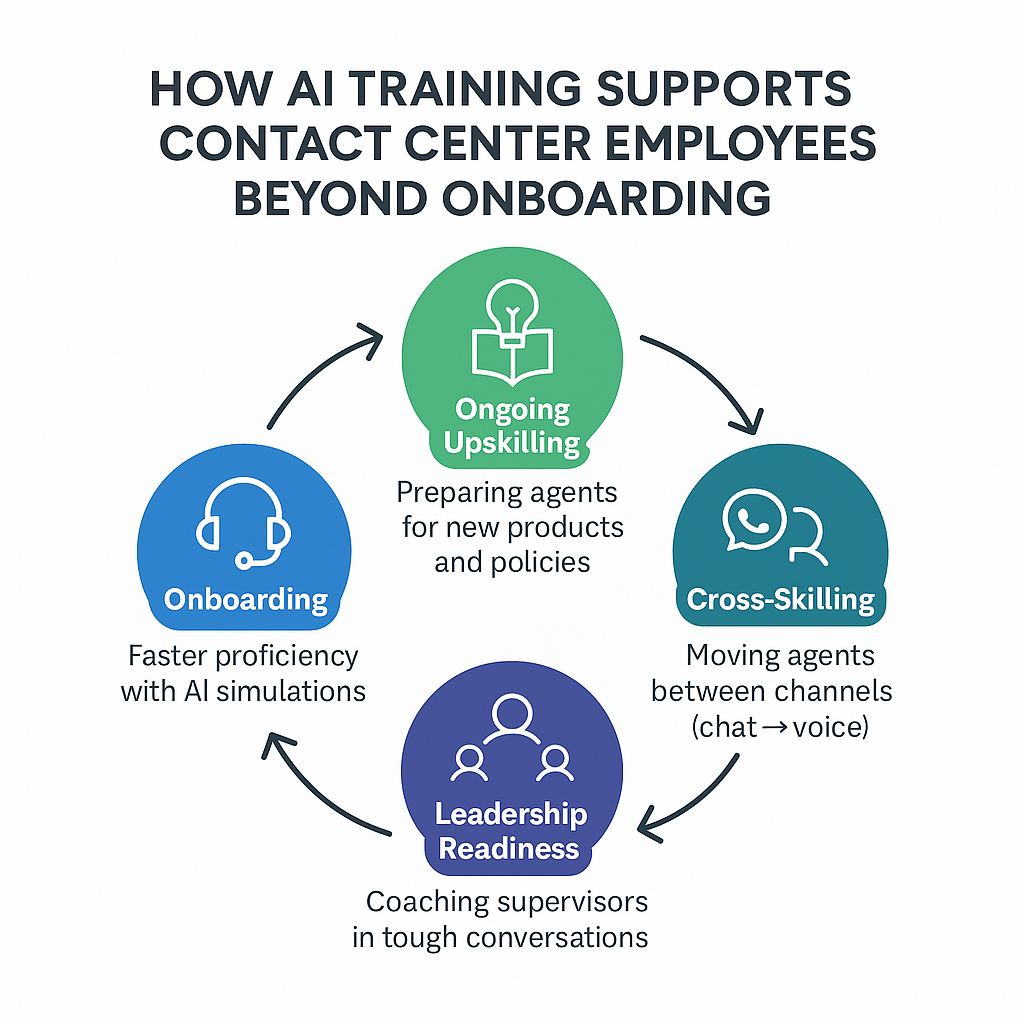
- Cross-Skilling Across Channels
Moving an agent from chat to voice, or from service to sales, has traditionally required significant retraining. With AI, simulations can replicate each channel’s dynamics — tone of voice, pace, and interaction complexity — making transitions smoother and more cost-effective. - Leadership Readiness
The benefits don’t stop with frontline staff. Supervisors and managers can use AI-driven roleplay to practice coaching conversations, performance discussions, and even conflict resolution. This prepares leaders to handle high-stakes interpersonal moments with the same confidence that agents bring to customer calls.
In short, AI training creates a continuous development ecosystem. It doesn’t just shorten the path to proficiency for new hires — it provides an adaptable platform that grows with agents, leaders, and the organization as a whole.
Measuring What Matters: Key Metrics for AI-Driven Training
For contact center leaders, adopting AI in training isn’t just about innovation — it’s about impact. The success of any program must be tied to clear, measurable outcomes that align with business priorities. By tracking the right metrics, leaders can prove ROI, refine their strategy, and ensure agents are truly ready for live customer interactions.
Here are the most critical measures to monitor:
- Speed-to-Proficiency: How quickly do new hires reach productivity benchmarks compared to traditional onboarding? Faster ramp times mean lower costs and earlier contributions to customer experience.
- Early Attrition: Monitor dropout rates within the first 90 days. A strong AI training program should reduce early exits by giving agents the confidence and preparedness they need to stay.
- First-Call Resolution (FCR) & QA Scores: Track whether new agents are resolving customer issues on the first attempt and adhering to quality standards. These are leading indicators of training effectiveness.
- Trainer Hours Saved: Calculate the reduction in time supervisors and trainers spend on shadowing and repetitive roleplay. Freeing up leadership capacity creates both cost savings and strategic flexibility.
- Agent Confidence Scores: Use post-training surveys or self-assessments to measure how ready agents feel before going live. Confidence correlates directly with performance under pressure.
When these metrics move in the right direction, leaders gain not only proof of value but also a framework for continuous improvement. The data transforms training from a cost center into a measurable driver of workforce effectiveness and customer satisfaction.
The Future of Agent Training: Intelligent Virtual Customers Take Center Stage
As contact centers evolve, so must the way we prepare the people at the heart of them. Intelligent Virtual Customers (IVCs) represent the next generation of training — moving the industry beyond static scripts and human roleplay into an era of AI-driven, hyper-realistic simulations.
What makes IVCs transformative is not just the technology, but the strategic outcomes they unlock:
- The Evolution of Simulations
IVCs behave like real customers — unpredictable, emotional, and varied — creating training that feels authentic, not rehearsed. This bridges the gap between theory and live customer interactions. - A Strategic Advantage for Leaders
By adopting IVCs, contact centers can shorten onboarding cycles, build agent confidence before day one, and reduce the costly churn associated with rookie stress and burnout. Early adopters will see measurable performance gains and a stronger competitive edge. - Creating a New Category
IVCs are not just another training tool; they are the foundation of a new category in workforce development. Just as AI assistants revolutionized self-service, IVCs are poised to redefine how organizations prepare agents for the realities of modern customer service.
For executives, the implication is clear: IVCs are no longer optional. They are the cornerstone of a future-ready workforce strategy.
Why Now Is the Time to Redefine Agent Training
The contact center is no longer defined by simple transactions. Agents step into complex, emotionally charged interactions from the moment they go live, and traditional onboarding models are no longer sufficient to prepare them. This new reality demands a new approach.
AI training for contact center agents, powered by Intelligent Virtual Customer (IVC) simulations, offers that approach. By restoring the broken learning ladder, providing safe but realistic practice, and delivering data-driven insights into readiness, AI-driven training transforms onboarding from a cost center into a competitive advantage.
For VPs and Directors, the decision is clear. This isn’t about testing a new tool on the margins — it’s about redefining how your workforce is built, developed, and sustained in an AI-first era. Leaders who embrace IVC-powered training will not only shorten time-to-proficiency and reduce attrition, but also build a confident, resilient agent base ready to deliver exceptional customer experiences from day one.
The future of customer service belongs to organizations that prepare their people as thoughtfully as they design their technology. With AI-driven training, that future starts now.
TL;DR: AI Training for Contact Center Agents
The challenge: Traditional onboarding is broken. Easy “starter calls” are gone, leaving new hires overwhelmed by complex issues on day one.
The solution: AI training powered by Intelligent Virtual Customers (IVCs) restores the learning ladder with realistic simulations, adaptive feedback, and measurable readiness.
The impact:
- Faster speed-to-proficiency
- Lower early attrition
- Higher FCR and QA scores
- Reduced trainer hours
- More confident, resilient agents
The opportunity for leaders: This is not a side experiment. It’s a strategic imperative for VPs and Directors to future-proof their workforce and sustain performance in the AI-first era.
Want more insights like this?
Subscribe to TrueCX's newsletter—the #1 resource for contact center trainers—for the latest in AI-powered training, team performance strategies, and real-world tips for building a stronger, smarter contact center, starting with contact center coaching.